Ecological Manifesto
WHO WE ARE AND WHAT WE DO:
We are an environmentally conscioustheatre company.
We prioritise sustainabilityand climate-conscious thinking. Making environmentally conscious work, to us, means making work with an awareness of our environment in both the formand the contentof what we create.
This does not indicate a strict set of rules to be adhered to, but rather a framework with which to approach the work - an expansive way of thinking. It means making work with an awareness that we are all interconnected, all living beings, with our environment. Humans are not superior to or apart from the world we inhabit. Sustainability is a nebulous word, open to many different interpretations, but to us it suggests a wide-angle view. It means thinking about the long-term as well as the short-term impact, thinking about things in relation to each other rather than in isolation.
An environmentally conscious approach to form means thinking about the physical impact of the rehearsal process, the production, and its afterlife - the practical considerations. An environmentally conscious approach to content can encompass work that specifically tackles themes connected to the environment or the climate crisis, as well as work that engages with ideas more broadly related to ecology.
Form and content are always in conversation with each other, and especially so in eco-theatre, which is grounded in an understanding of interconnection.
In terms of form, the actions we take now include:
Staging several shows outside in natural settings, something we believe can offer real value in helping people reconnect with their local natural environment. Additionally, a 2014 study found that 70% of the power consumed by the average theatre is used for heating and air conditioning – i.e. for the theatre building itself. [1]
At least 70% of design materials used in our productions have had a life before and/or will have a life after. This was inspired by a conversation with and article [2] by Sandra Goldmark (a similar principle can be found in the Theatre Green Book)
We complete a waste budget for our shows – a document which tracks the source, collection method, and destination of everything used in a production. We learnt about this strategy from The Greenhouse Theatre
We also adopt Greenhouse’s philosophy of not letting perfect be the enemy of good - e.g. conscious off-setting as a last resort if our attempts to secure eco transport have fallen through
We do not use AI for any part of our creative process, and ask creatives working with us to take this same stance
In terms of content, our work:
Sometimes has an explicitly environmental theme
Refutes the idea of hope as a “product” [3] that environmentally conscious work owes its audiences – we aim instead to provoke new ways of thinking and start conversations
Originates from a place of climate-conscious thinking – a piece might not have an explicitly environmental theme, but this mode of thinking and the concerns we share as a company permeate all the work we make
There are many different systems by which you can measure your production/company’s environmental impact. In Ireland, the Green Forum as part of Performing Arts Forum has lots of resources available, and offers occasional events such as Climate Adaptation workshops. They released an Irish version of the Theatre Green Book, applicable to both venues and companies. This offers clear guidance and guidelines, as well as freely available online tools to track your production or venue’s environmental impact. Julie’s Bicycle Carbon Calculator is another great resource, also freely available online.
We evaluated the environmental impact of three of our projects in 2025, and have published the results below.
We are still figuring out what being an environmentally conscious company means to us, and believe that we always will be. We are concerned with what an environmentally conscious process looks like – something that will naturally evolve over time and on different shows – not with establishing a fixed idea of an environmentally conscious production.
Our work is ensemble-based, collaborative, and inclusive, principles that are, for us, rooted in ecology. We want to celebrate the other makers creating environmentally conscious work and sharing ideas, techniques, and guidelines. We are all part of an ecosystem of theatre-makers and audience members, an interconnected web that, cumulatively, can shift perspectives and pave the way for real change.
WHO WE WANT TO BE:
We are a young company – founded in 2018 – and think it’s important that we share our perspective. The resources available are often more relevant to large, established companies, rather than emerging makers. These are people (us included) for whom it might not be relevant, for example, to encourage more conscious energy consumption in the office, given they are unlikely to have an office at all.
Eco-theatre is, in many ways, very accessible: less money means less resources means less consumption. And applying a collaborative approach that prioritises interconnection is (naturally) free. Many of us are probably making sustainable work without even realising it – deciding to actively frame this work as environmentally conscious can offer a useful shift in perspective and encourage further action.
We want to highlight that eco-theatre can be both accessible and fun. It doesn’t have to be worthy, or preachy, or excessively reserved in design. Sandra Goldmark suggests adopting an environmental budget in the same way all productions, by necessity, have a budget of time, space, and money. This means that no-one feels like a bore or a killjoy for bringing environmental considerations into creative discussions: an environmentally conscious approach should serve as a catalyst for experimentation, not a point of restriction.
In terms of concrete goals for our future as a company, we aim to:
Have a dedicated ecodramaturg on future productions, who ensures climate-conscious thinking remains woven into the process throughout
Host workshops sharing our process and perspective
Create an eco-pledge [4] to add in to all future funding applications that clarifies what we will do and why we do it
Make this pledge freely available for other companies to include in their applications - a way to hold ourselves accountable and help others do the same
Publicise our waste budget for each new show, and encourage other companies to do the same
Have everyone on our team read our manifesto before we begin work together to ensure we are all coming from a place of shared understanding
Be unafraid to question larger bodies we work with about their own practice and its sustainability – to start conversations and encourage change
WHY WE DO IT:
Ultimately, we make environmentally conscious work because we care.
Yes, 80% of greenhouse gas emissions come from just over 50 companies. [5] Circular design probably won’t save the world. One play is unlikely to change government policy. But getting bogged down in statistics is always going to suggest action is pointless – that doesn’t mean those of us not in those 50 companies should sit back and do nothing. We have been conditioned to think that we need to be able to see immediate, tangible effects from our actions for them to matter. But if you care, it matters. [6]
We want to move beyond the lens of “efficiency.” [7] To us, making environmentally conscious work is not about striving for the most efficient means – because, crucially, “efficiency” isn’t a neutral term anyway. For example, presenting work outside reduces energy consumption in the theatre, but is likely to increase it in audience members’ modes of travel. Sustainability isn’t black-and-white. We want to make work with a creative, expansive way of thinking – one that encourages play, embraces interconnection, and accepts imperfection. We want this work to be part of a greater movement, a theatrical ecosystem that is striving to invite more people into the conversation. This may not conform to traditional, linear understandings of change-making; we might not see results instantly or in immediately recognisable ways. But we will continue to make this kind of work, and talk about this kind of work, because we care about the natural environment we are a part of – the network we share.
REFERENCES:
[1] This study was shared on the National Theatre UK’s website but is no longer available - last accessed in 2021.
[2] This article is called “Circular Design and Production” by Sandra Goldmark, 2019.
[3] We are grateful to Silke Huysmans and Hannes Dereere for the framing of this idea.
[4] We copied this idea from Collectief Walden, a Dutch collective founded in 2013. They created an eco-pledge called to be or not to be, which was widely shared and added to funding applications in the Netherlands. In it, they listed actions “for art in times of climate breakdown.”
[5] https://www.theguardian.com/environment/2024/apr/04/just-57-companies-linked-to-80-of-greenhouse-gas-emissions-since-2016
[6] Our thinking here was shaped by this article by Oliver Burkeman: https://www.theguardian.com/lifeandstyle/2019/jul/19/skipping-flight-might-not-save-arctic-but-shows-you-care-oliver-burkeman
[7] Our ideas here were informed by Being Ecological by Timothy Morton, 2018.
Ecological Manifesto (with annotations)
We presented an annotated version of our manifesto as part of Rough Weekend at the Project Arts Centre in December 2025.
In this presentation, we offer reflections on our real experiences of trying to make this kind of work: discoveries, accidents, and mistakes.
We also offer broader reflections on what this kind of work, and these kinds of ideas, mean to us.
You can watch a recording of the presentation below. We are grateful to Rough Magic and the Project for the opportunity to present our manifesto in this extended format.
Pledge
A freely available pledge for you to sign and attach to any applications or submissions you wish to.
Creative Climate Tools 2025: Results
-
![]()
2025 Overview
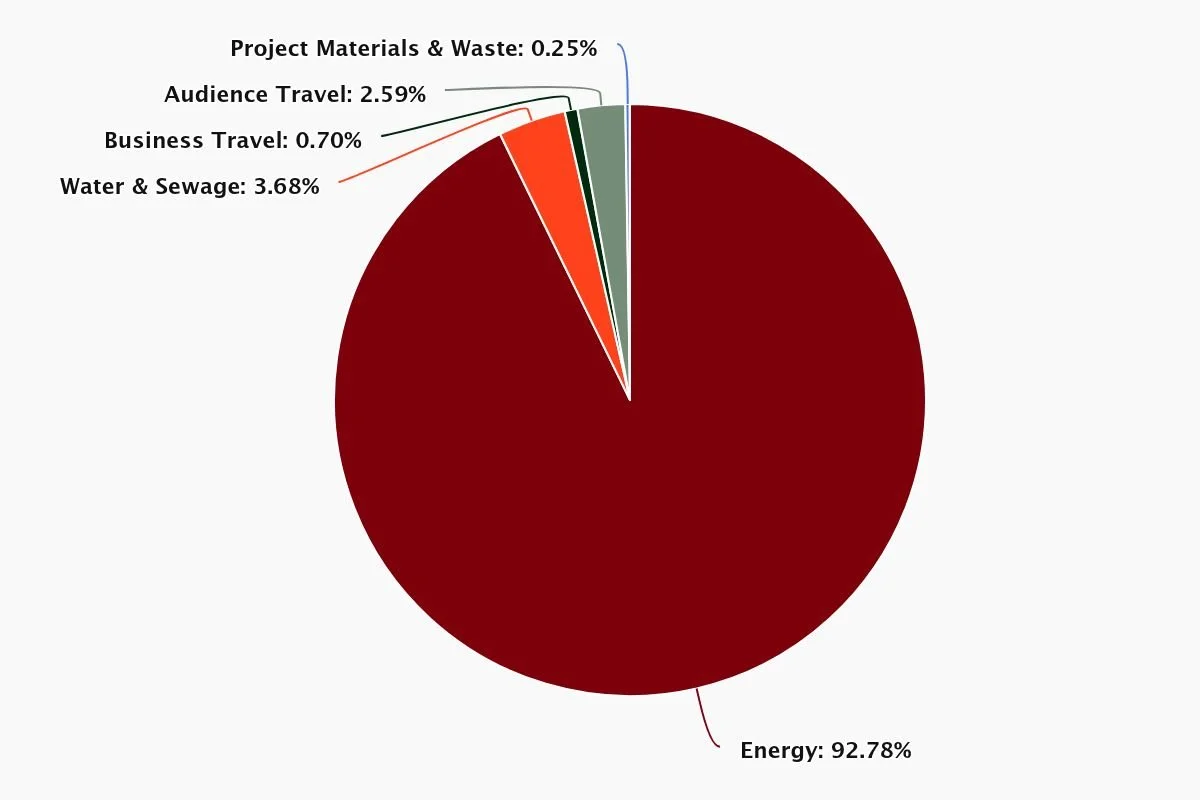
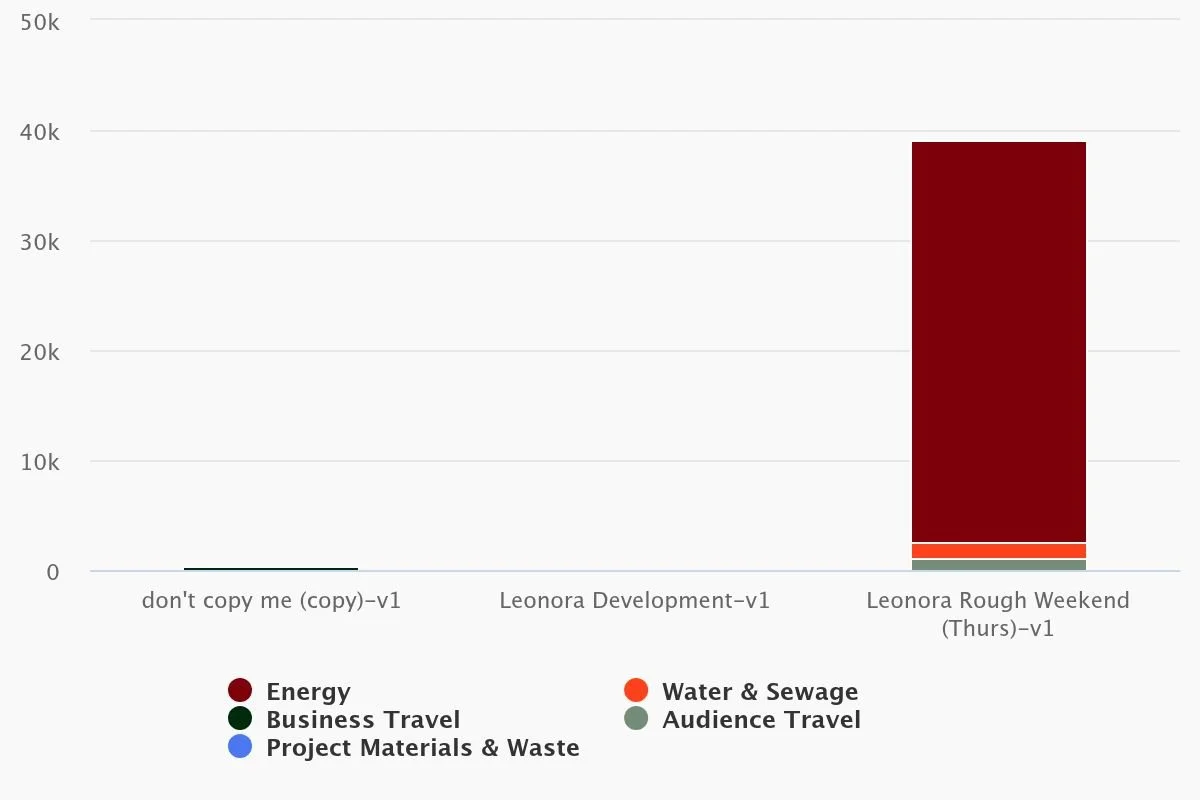
This is an overview of our carbon footprint (39tonnes CO2e) for 2025. It covers don’t copy me (copy) at Dublin Fringe, development of LEONORA in Fringe Lab, and Rough Weekend at the Project Arts Centre.
However, as discussed in our annotated manifesto above, this figure is not really representative of our own consumption. We are not able to isolate readings for one space within a larger venue - which is why “energy” takes up a massive 92.78% of our carbon footprint, even though only a fraction of that will have been used to power our shows or accommodate our audience members.
-
![]()
don't copy me (copy)
16th-20th September
Patrick Sutton Studio, Smock Alley Theatre
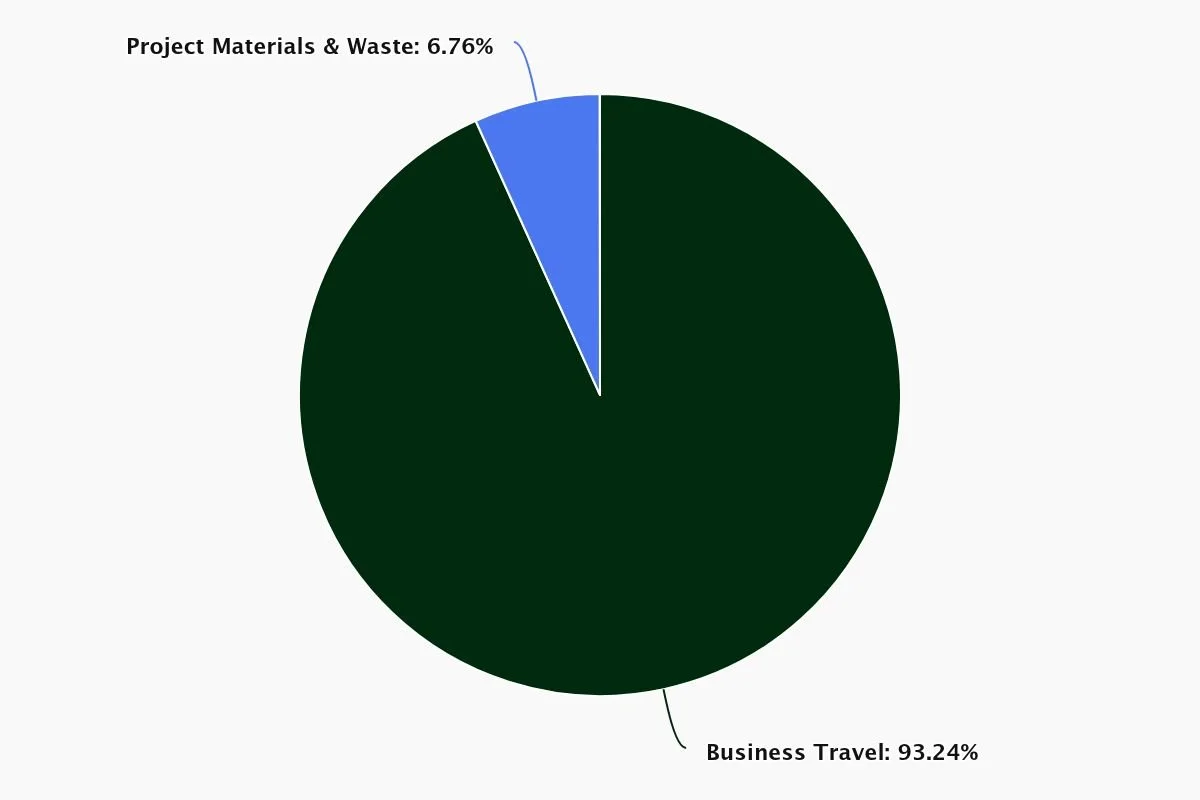
We are learning: we didn’t ask audience members how they travelled to us. We did not ask Smock Alley to read their water, gas, or electricity metres before or after the run. Although once again, the usefulness of these figures in a venue with three performance spaces as well as a bar, box office, and a reception space is debatable. (Although we would contribute to use of spaces such as the bar and box office, it is difficult to isolate our own contributions here).
And no, we didn’t taxi in every day - that 258 kg CO2e on “business travel” is Doris flying over from Amsterdam.
-
![]()
LEONORA development
Fringe Lab Studios, 29th September - 10th October
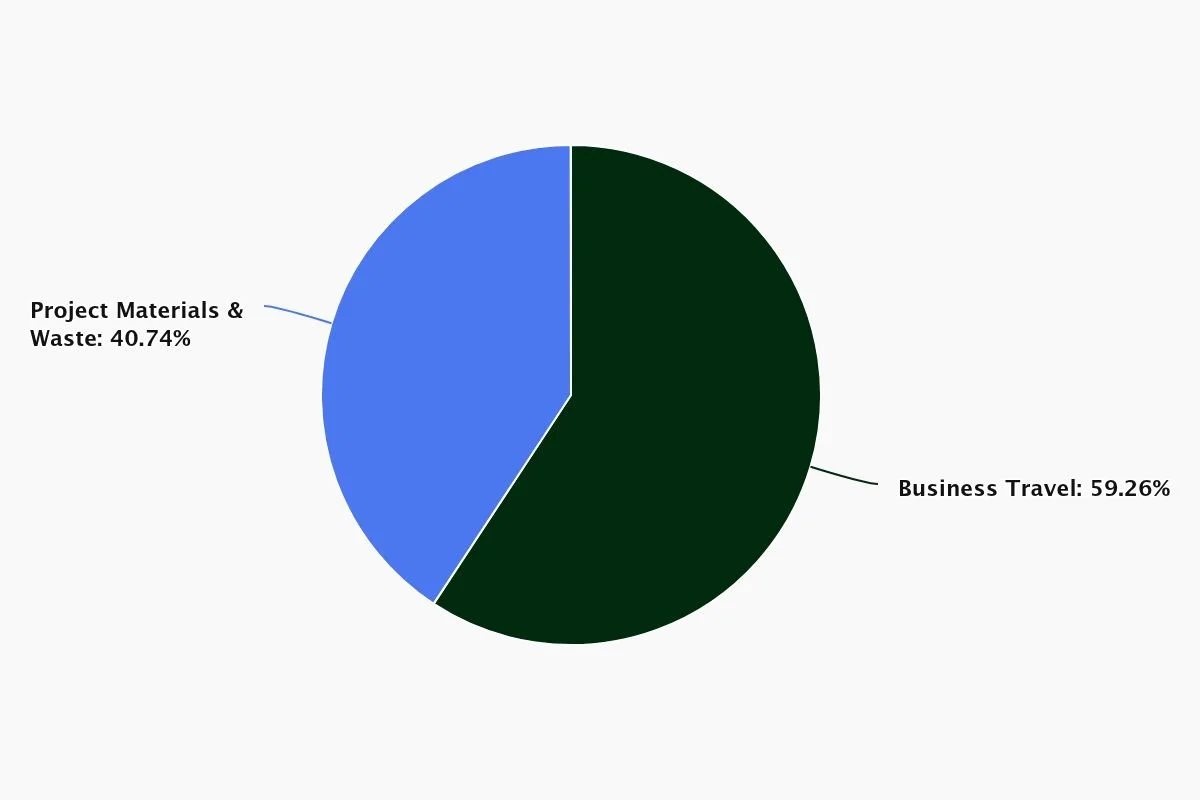
Once again, we did not obtain figures from Dublin Fringe regarding water, gas, or electricity. As a small group in one studio of a busy Fringe HQ, we think it is fair to ask whether the effort expended on calculating these figures is rewarded, given the relatively impossibility of their being accurate.
No-one flew over for this one - but we needed several trips by car for transport of equipment.
-
![]()
Rough Weekend
Project Arts Centre Cube, 18th - 20th September
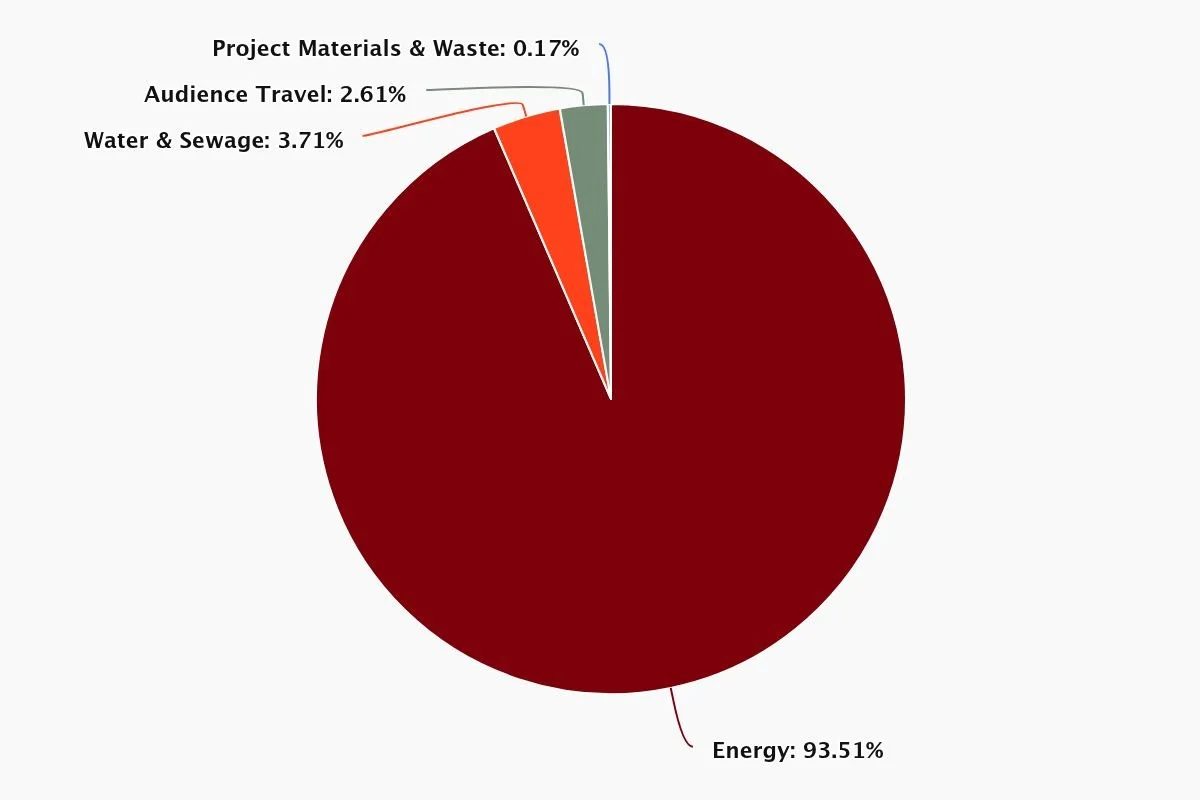
For this project, we asked for readings of water, gas, and electricity metres before our show on the 18th and after our show on the 20th. On the 18th, we asked audience members at the door how they arrived. The 19th was a showing by Arinola Theatre, and the 20th was a selection of showings by other makers alongside us, so we did not repeat this on those days.
This chart highlights the potential of such tracing methods to veer into obfuscation: while both our shows and audience members will have contributed to energy use at the Project Arts Centre, we are not responsible for the energy use of a building that size as a whole. We asked for the square ft of the building to attempt a division, but the Project team were unable to access up-to-date figures at the time.
-
![]()
Side-by-side comparison
-
![]()
Reflections
We struggled with this. We felt we should give it a fair go - but to be honest, we found the process quite boring, frustrating, and offputting. That is why we want to suggest an alternative method of making climate-conscious work. If you don’t own or manage a building, as long as you have a waste budget, plan carefully and track consistently, you are probably making substantial enough a difference for it to be - and feel - “worth it.”